
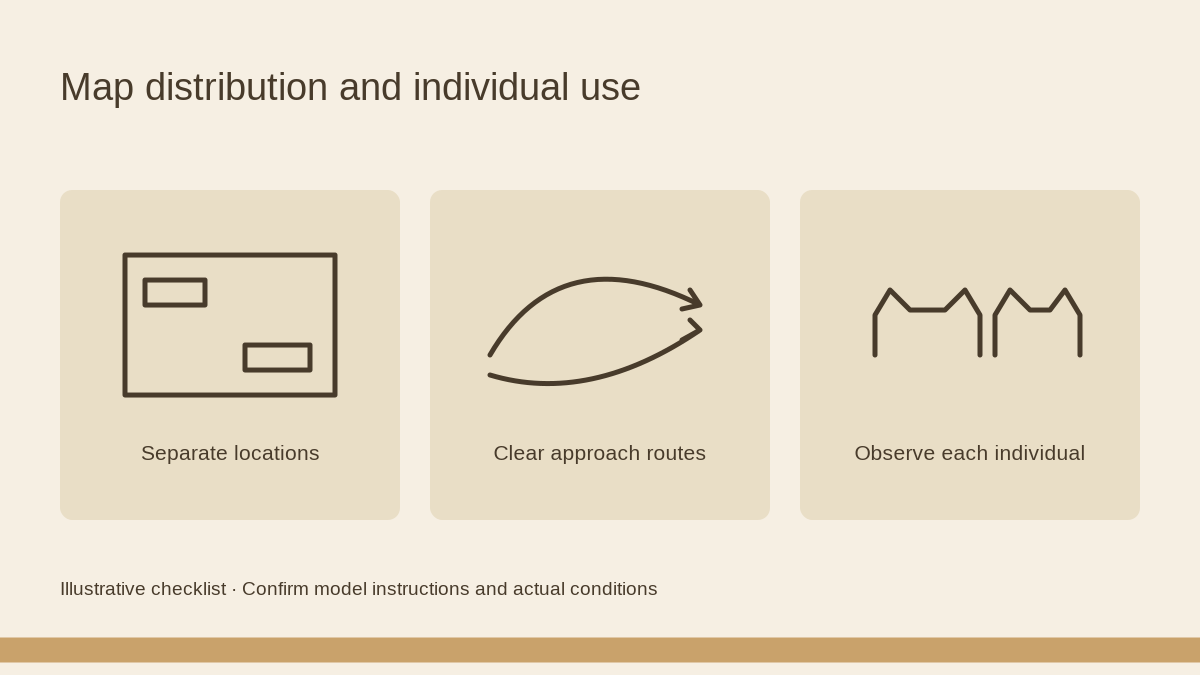
Distribution matters
The AAFP/ISFM environmental-needs brochure recommends multiple, separated resources and choice for cats. A collection of scratching items in one corner should therefore not be treated as equivalent to accessible choices in different locations. The household’s layout and relationships need consideration.
Map access for each cat
Sketch the rooms, resting places, entrances and existing scratching locations. Note which cat uses each area and whether access appears to be blocked. Record observations without diagnosing a social or medical problem. The map helps identify questions to discuss with the owner and, where needed, a veterinary or qualified behaviour professional.
Compare the practical configuration
For each proposed location, list orientation, footprint, installation needs and care access. Compare separate compact items with a larger combined structure using the actual layout. Do not assume that a product advertised for multiple cats has a proven capacity or removes conflict.
Prepare a responsible retail bundle
A useful bundle description explains the individual items, suggested placement considerations and replacement parts. Avoid promising that a fixed item count will solve household behaviour. Procurement teams should verify the dimensions and support requirements of each model before creating room-layout or capacity claims.
Map access for each cat rather than counting products alone
Draw each scratching location and record which cats can reach it without passing through a narrow or contested route. Several boards grouped in one corner may provide less independent access than resources distributed across useful locations. Observe each cat where possible and record blocking, avoidance and voluntary use without assigning blame. The environmental-needs guidance supports attention to resource access and individual preferences, but this checklist does not establish a guaranteed product-to-cat ratio. A retailer can use the map to discuss different footprints and orientations rather than claiming that a larger bundle resolves household conflict.
A checklist to save and compare
Question | Record for each cat | Product planning |
|---|---|---|
Can it reach a surface? | Route, obstacles and observed blocking | Consider separate reachable locations |
Which setup is used? | Orientation, location and voluntary use | Offer clearly measured alternatives |
Can use be maintained? | Wear, movement and maintenance access | Plan model-specific checks and replacements |
Compare current model specifications
FAQ
Does a larger bundle solve competition?
A product count alone cannot show whether each cat has comfortable access. Observe location, routes and individual use.
Is there a guaranteed scratcher-to-cat ratio?
This guide does not set one. Use the cited environmental guidance and individual household observations; seek professional help for persistent conflict or distress.
Should all surfaces be identical?
Do not assume identical preferences. Record what each cat uses and compare dimensions, orientation and placement before choosing a range.